
One of the things I always say is that things will unfold as they should. I’m obviously not the only one who says this and I’m certainly not the originator of that idea. The phrase actually comes from Max Ehrmann’s 1927 devotional poem called Desiderata (which is the Latin word for ‘desired things’). If you’re a child of the ’60s or even ’70s, you will be familiarly with this poem. You (or your parents) might have had the poem on a poster, t-shirt, fridge magnet, toilet seat cover, embroidered tea cozy, or hand painted wall mural.
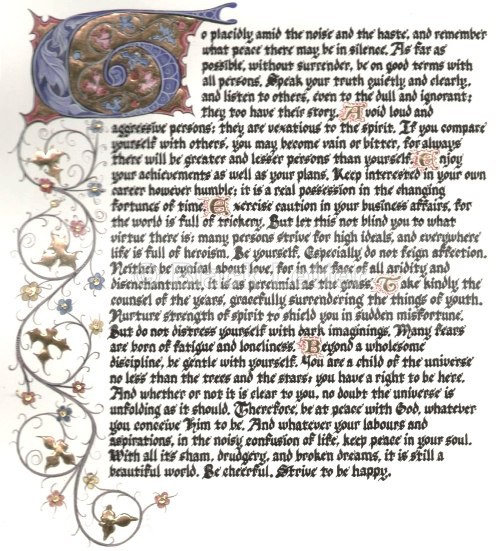 To this day, you can buy parchment versions of the poem with its iconic illuminated letter G (Go placidly…”), like it was written by some lonely, half blind medieval monk. Desiderata is part of the canon of my childhood. Suffice to say, it was the anthem of a generation.
The passage in question goes thus:
You are a child of the Universe, no less than the trees and the stars;
You have a right to be here.
And whether or not it is clear to you, no doubt the
Universe is unfolding as it should.
Interestingly, the poem was never famous in Ehrmann’s lifetime. It’s as though he wrote it in preparation for another time…yet to come. A time when people would begin asking questions, challenging tradition and, most importantly, recognizing that self-worth was a birth right. It seems he wrote it for the dawn of the Age of Aquarius. Desiderata, written before the Great Depression, is eerily enlightened. Even more bewildering is that Ehrmann was a lawyer…a profession in which waxing poetic about the soul and destiny is unorthodox (and unexpected) to say the least. He was also 54 when he wrote the poem. This fact is only interesting in that it gives me hope that fame is possible in later life.
Desiderata ended up on spoken word records in the 70s, the oddest of which may be a recording by Leonard Nimoy on his 1968 album entitled Two Sides of Leonard Nimoy. I kid you not. If you search YouTube, you’ll find a number of readings, but I highly recommend the version read on SpokenVerse’s channel.
So, that’s where the saying comes from…but what do we mean when we say it? I’ve heard atheist, agnostic and believer alike utter these words. How can they all believe it’s true…that all things will unfold as they should? Because to utter these words is to believe that there is an order to everything we do that ultimately ‘works out.’ Somebody or something’s got a plan, in other words.
It’s as though life is a huge box of puzzle pieces and they magically fit themselves together as we progress through life. We often try to do the puzzle solving ourselves, to no avail. Why? Because we can’t see the big picture..literally. I’m talking about the one on the puzzle box of the whole image. That’s what you use to help complete the puzzle, to organize pieces and gauge your progress.
That, my friends, is the kicker. We do not know how we fit into the grande scheme. Are we an edge (very handy!), an obvious detail we can identify and place quickly, or an amorphous shaped colour among a hundred others?
More than that though, we tell ourselves and each other that things will unfold as they should to comfort ourselves against the horrible realization that there is very little in life we can actually control. Random events are destabilizing. I wrote in a previous post about choices and how one small choice can create a cascade of huge consequences. I think about the woman in Quebec who stopped her car to help some ducklings across the road. A motorcyclist speeding from behind didn’t stop in time. He and his passenger were killed and the woman who stopped her car to do something kind is now (unbelievably) facing life in prison. One choice.
As I think about that poor woman, I wonder how this is life unfolding as it should. Why ‘should’ this happen. What larger purpose does this tragedy serve? What will “unfold” as a result?
The other kicker is that we can’t make sense of the events except by looking in the rear view mirror. It’s only then that we can see how decisions and events conspired to create meaning. Knowing gives us evidence. And evidence, girls and boys, is comfort. Evidence is the antidote to superstition and delusion.
The idea that things unfold as they should (not necessarily as we want) does give me comfort. I like knowing that order trumps chaos. I like knowing that there is cosmic purpose to everyday choices and events. I like knowing that I’m playing a role in this giant puzzle…even though I’ll never know what that role is until the time comes for me to see the puzzle box.
Jimmy Stewart’s character got a preview in It’s a Wonderful Life. He got to see how it all fit together. He saw that he wasn’t a cog, but the hub around which an entire town turned. It made all the difference. I envy him that gift.
It makes me wonder: if you could see the role you’ve played in the grand scheme of things, how would that affect you going forward, if at all? Would you be more mindful of your choices? Would you be paralyzed by second guessing your choices? Would you feel unburdened, knowing that you were needed…that without you, the puzzle would remain unfinished.
Ultimately, I believe that our lives are about fulfilling our purpose in the puzzle. We may achieve that purpose quickly or it may take a hundred years. In any event, when we’ve done our part, we leave the field, climb to the top of the stadium and look down at what we’ve helped build. The knowing will be joyous…because we will see, finally, that we were essential to life. And that everything indeed unfolded as it should.
**dedicated to Jody Lundell and Laurie Barnstable, whose contributions to life are much and many**
 ed food, for example, to calm your nerves and comfort yourself, then your brain has hard wired that connection in. Eating = no anxiety. Powerful association!
 The Age of Sage